

what is it that you might say?

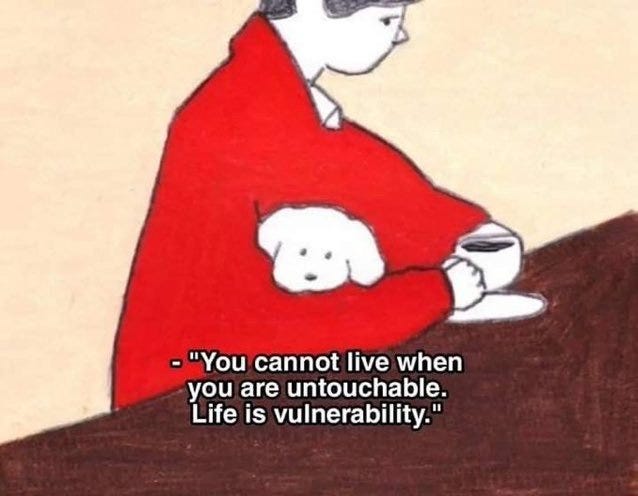
When I was in my early twenties, I was in Vancouver for a business meeting. It was the first time I had ever travelled for work. I grabbed lunch with a girl I had worked with a few years ago. She had recently moved to the city. I was visiting and felt a little adrift in the day before my meetings began. We sat down across from each other at a dark wood table in a restaurant designed to feel like a ship. Wood, everywhere. Netting on the walls. Plastic crabs tangled in the brown, gaping threads.
How are you? I asked this girl I had worked with, realizing that I fundamentally knew nothing about her, except that when we had worked together, she had been very good at her job.
Well, the girl said looking directly at me. I’m really lonely.
*
Until that day in the belly of a ship that was not a ship, I didn’t know you could say something like that out loud. I thought you had to keep those kinds of things to yourself. Or, if you were going to say it, then you had to say it with some kind of winking irony that pre-empted the judgment that I believed would follow.
But I felt no such judgement when the girl told me how she felt. I actually felt a sudden an unexpected intimacy. This girl who seemed nothing like me externally, was perhaps, internally, very like me indeed.
*
It’s not particularly groundbreaking to say that vulnerability strips away the fundamental idea that we have nothing in common but I’m thinking about it a lot lately. There’s a kind of way about the internet right now that’s a type of softness, trying to be brave: I am cringe but I am free, this kind of thing (also sorry
for flooding your DMs when I started talking about this with you last week!).I’m caught on this kind of language because it’s so obviously protective. It’s reaching for vulnerability without removing any of the artifice or the bracing against how it might be received. There’s a defensiveness in this kind of language’s posturing that inherently works against the vulnerability the language is striving towards.
*
I am going through something difficult right now. I feel alone around others because mostly no one knows that I am experiencing this particular difficulty. That’s my choice. But I also feel alone in myself. And that isn’t something I have chosen.
The difficulty has cast many of the things I hold to be true about who I am and what I am capable of into a seasickness of uncertainty. I genuinely do not feel capable of the things that I once did — even writing feels out of reach.
Recently, I was talking to a friend about some work that I am struggling to break through on and at one point, I just said: I really don’t think I can do it.
And it wasn’t until I said it that I realized how much of my own identity seasickness was surging behind that little, honest admittance. After I ended the call with my friend, I sat down in the middle of my studio and almost cried, except that I couldn’t because if I started crying now, I really wasn’t sure what the way to stopping would be.
*
A few days ago, I was somewhere near the back of Costco, facing a wall of plastic-wrapped toilet paper, the particular kind that I wanted, not on sale.
I really don’t feel like I know who I am right now, I said.
I was tearing up but there were still things to do. Super packs of green tea to locate.
That’s hard to hear, J said, tenderly. I am sorry you’re feeling that way.
I had almost-cried no less than four time since we entered Costco by the row of televisions all representing the same digitally enhanced image of Paris. Sixteen blinking, high-resolution slow-pan images of the Arc de Triomphe.
Years ago, when I was a teenager, I saw the Arc for myself but I refused to walk up the many stairs to see the city from its perspective. Or, perhaps I did actually walk the stairs, and see Paris in all its blocky and historic architecture stretching out before me. Walking the replicating aisle of Arcs, I can’t remember what I actually chose to do. All I know is that I saw the Arc on a gray day, not unlike the one that waited outside Costco.
J asked if there was anything he could do.
That’s the problem, I told him. I feel like I can’t do anything. My life feels out of my reach.
*
I am, amid the difficulty of my present time, also have a perfectly lovely life. The hydrangea I thought for sure died while we were leaving in temporary housing seems like it may have survived in the backyard. J creates perfect salads for me and brings flowers home that open, gently and fully for the light. The trees across the river are greening. I have faint tan lines from walking the path. I get to write as part of what I call my living. My body moves me to run and I can.
And there is a great and looming difficulty, a tossing seasickness in my sense of self because of it. I think, or I suspect anyway, that most of us might actually feel some kind of difficulty, right now. That, in fact, much of life can be quite difficult and we are also, perhaps, a little afraid to keep saying that. Out of superstition perhaps or, more likely, out of the same inhibition I felt that day in the ship: a shadowed sense that there are some things you just don’t keep saying aloud.
*
During a strange and jarring moment a few years ago, a person I had known for a long time was in the midst of very bluntly ending our friendship. Part of the conversation involved this person telling me that they had come to realize that we were all fundamentally alone. That no matter what we shared or who we loved or what we lost, nothing could ever touch the core, enduring loneliness of the human being. They told me they had come to believe it was better to keep the deepest parts of their existence to themselves.
It wasn’t that I disagreed on the part of essential loneliness. I really do think there will always be parts of our experience that we cannot entirely convey to anyone, that we might struggle, even, to understand for ourselves, but what I did not understand was the conclusion this person had drawn. This idea that solitude was somehow better (more moral?!) than connection.
*
This was a difficult letter to write. I did not want to be quite so plain about myself with you but regardless of whether you know the exact shade and texture and grain of my difficulties, or even of the loveliness too in my living, I believe somewhat relentlessly in the practice of saying the thing as vulnerably as I can. So, here I am.
I wonder too, if you could be allowed, as I was all those years ago in that shiptaurant, into just saying the thing as clearly as you could: What is it that you might say?
I finished your book this past weekend. I had come to the same conclusion about the essential loneliness of being human. And just bearing that pain forever. I had lost my love at 23 just after having our baby. All these years I never could explain how that wrecked me. I kept quiet about how beautiful he was. No one wanted to hear that. Then I read your book. Thank you thank you Amy. And. The baby is now 27.
My mother passed away ten days ago from cancer. It was a long illness and it was harrowing. I suffer from complex PTSD due to childhood trauma related to my mother's alcoholism and abuse. I took care of her throughout her illness until she went into hospice care in a care home. There I spent hours everyday with her until the end. I advocated, fought for her care, for her dignity, for her voice to be heard, as she had lost the ability to communicate in February after a stroke. One could say I mothered my mother throughout this ordeal. And with her passing, the fact that she didn't mothered me has become painfully ingrained in my mind. I also love her more than I thought possible given what she put me through. And I'm grieving, which I didn't think I would be, or at least, I wouldn't come undone. I'm unraveling and I'm scared of what's at the end of the unraveling.